"No time", "the gym is far", "too expensive", "I'm embarrassed in front of others". In 2026 none of these excuses hold anymore: you can get real results training at home, with no equipment, in 30-45 minutes a day. The only non-negotiable ingredient is consistency for at least 12 weeks.
In this guide you'll find the complete program to train bodyweight: the 10 essential exercises covering all muscle groups, two weekly plans (beginners 3 days + intermediates 5 days), how to progress without external loads, coordinated nutrition and when it makes sense to consider the gym.
Can you really get results without weights?
The honest answer: depends on the goal. Bodyweight training has specific pros and cons.
What you CAN achieve bodyweight
- Fat loss: achievable by combining bodyweight + caloric deficit (a fat loss plan can be done entirely at home)
- Cardiovascular endurance: excellent with HIIT bodyweight circuits (burpee, mountain climber, jumping jack)
- Mobility and posture: often superior to the gym, because you work in natural patterns
- Relative strength (relative to bodyweight): very high, especially with advanced calisthenics
- Hypertrophy in the first 12-18 months: present but limited, more visible in upper body
- Motor coordination: great thanks to pattern variety
- Mental health and consistency: highest, due to immediate access and low friction
What you CANNOT achieve (realistically)
- Massive hypertrophy (competitive bodybuilder): needs progressive external overload
- Absolute max strength: needs heavy loads (80%+ 1RM) bodyweight doesn't provide
- Specific development of hard-to-reach muscles (hamstrings, lower traps) without equipment
For most people with "stay fit, feel good, look defined" goals, bodyweight covers 80% of fitness needs.
Bodyweight training principles
Bodyweight, progressive overload (rule number one of adaptation) applies in different ways than weights. The 7 levers to progress:
- Increase reps: from 10 push-ups to 15 to 20
- Increase sets: from 3 sets to 4 to 5
- Change mechanical leverage: classic push-up → decline → pike → handstand push-up
- Isolate on a single limb: two-leg squat → Bulgarian squat → assisted pistol squat → full pistol squat
- Slow the eccentric phase: 3 → 4 → 5 seconds down
- Reduce rest: from 90 seconds to 60 to 30
- Intensity techniques: drop-set, isometric hold, rest-pause, cluster set
Combining these levers you can progress for 2-3 years without ever buying equipment.
The 10 fundamental exercises
Push (upper body pushing)
- Push-up — chest, shoulders, triceps. Beginner variant: on knees. For advanced: decline on chairs, diamond push-up.
- Pike push-up — shoulder emphasis. "Inverted V" position, push upward. Evolution toward handstand push-up.
- Chair dip — lower chest and triceps. Use stable chairs weighing equal or more than you.
Pull (pulling)
- Under-table pull-ups — back + biceps. Get under a sturdy table, grab the edge and pull up. May seem ridiculous but works.
- Door towel row — back. Close a towel in a sturdy door, grab both ends and lean back pulling.
Legs and glutes
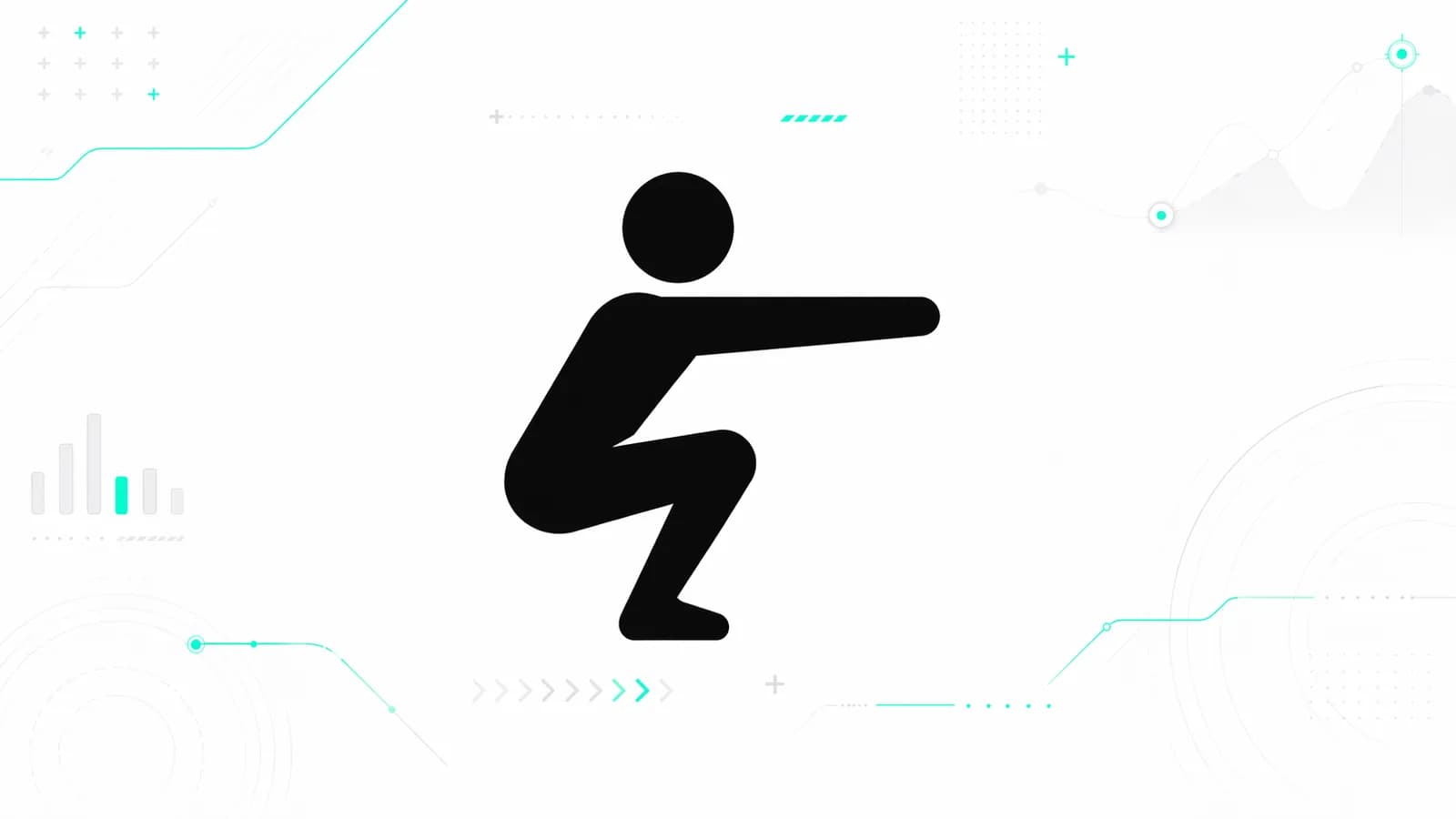
- Bodyweight squat — the king of bodyweight. Progression: slow squat (5 sec descent) → squat jump → assisted pistol → full pistol. For serious results you also need 50-100 reps/session.
- Lunges — infinite variants: forward, back, lateral, jumping, Bulgarian. Hit quads, glutes and stabilizers.
- Floor hip thrust — isolates glutes. Progression: 2 legs → 1 leg → with loaded backpack.
Core (abs and stabilizers)
- Plank — from classic to side to plank with alternating leg raises. Works all deep core muscles.
- Mountain climber / Hollow body hold — cardio + core hybrid. High metabolic stimulus, burns many calories.
Bodyweight session structure
How to structure an effective 40-minute session:
- Dynamic warm-up (5 min): shoulder circles, jumping jack, skip in place, leg swings
- Activation (3-5 min): glute bridge × 15, bird-dog × 10 per side, cat-cow × 10
- Main exercises (20-30 min): 4-6 exercises, 3-4 sets each, with adequate rest
- Final core (5-8 min): 2-3 specific abs and stability exercises
- Stretching (5 min): decompression and base mobility
Total duration: 35-50 minutes. Less than 20 min is insufficient for training stimulus. More than 60 min raises overtraining risk without proportional gains.
Beginner 3-day plan (Full body)
Ideal for those starting or returning after a long break. Monday / Wednesday / Friday.
| Exercise | Sets × Reps | Rest |
|---|---|---|
| Bodyweight squat | 3 × 12-15 | 60 sec |
| Push-up (knees if needed) | 3 × 8-12 | 60 sec |
| Glute bridge | 3 × 15 | 45 sec |
| Door towel row | 3 × 10-12 | 60 sec |
| Static lunges | 3 × 10/leg | 60 sec |
| Plank | 3 × 30-45 sec | 45 sec |
| Mountain climber | 3 × 30 sec | 45 sec |
Recommended monthly progression:
- Month 1: total focus on technique. Better few well-done reps than many badly-done.
- Month 2: increase reps (from 12 to 15, from 8 to 12 push-ups).
- Month 3: increase sets (from 3 to 4), or slow eccentric (4 sec down).
- Month 4: move to harder variants (decline push-ups instead of classic, jumping lunges instead of static).
After 3-4 months of this plan, move to the intermediate plan below.
Intermediate 5-day plan (Upper/Lower split)
For those with 3-4 months of bodyweight behind them. Monday/Tuesday/Thursday/Friday + Saturday or Sunday light.
Monday — UPPER (pull-dominant)
- Under-table pull-ups: 4 × 8-12
- Towel row: 3 × 12-15
- Classic push-up: 4 × 10-15
- Pike push-up: 3 × 8-12
- Plank: 3 × 60 sec
Tuesday — LOWER (quadriceps)
- Bulgarian squat: 4 × 10/leg
- Squat jump: 3 × 12
- Walking lunges: 3 × 12/leg
- Wall sissy squat: 3 × 10
- Side plank: 2 × 45 sec/side
Wednesday — ACTIVE REST
Walk 40-60 min, gentle yoga or joint mobility. Don't stay completely still: active recovery accelerates.
Thursday — UPPER (push-dominant)
- Decline push-up: 4 × 10-15
- Diamond push-up: 3 × 8-12
- Chair dip: 4 × 8-12
- Slow pike push-up (5 sec eccentric): 3 × 6-8
- Hollow body hold: 3 × 30-45 sec
Friday — LOWER (posterior and glutes)
- Single-leg hip thrust: 4 × 10/leg
- Glute bridge walk-out: 3 × 12
- Reverse lunges: 3 × 12/leg
- Alternating shoulder-tap plank: 3 × 45 sec
- Mountain climber: 3 × 40 sec
Saturday or Sunday — LIGHT
One of the two: complete rest, the other a walk/light bike 45-60 min or yoga session.
How to progress beyond intermediate
After 6-9 months of serious bodyweight, you can explore three directions:
1. Advanced variants (pure calisthenics)
- Full pistol squat: the holy grail of bodyweight for legs
- Handstand push-up: pushing vertically with hands
- Muscle-up: pull-up + dip in one continuous movement (needs external bar)
- Planche / Front lever: advanced isometric skills, require months of progression
2. Low-cost equipment (50-150€ total)
- Door pull-up bar (40-60€): unlocks real pull-ups and L-sit
- Parallettes (30-50€): deep push-ups, handstand, L-sit
- Resistance bands (20-40€): pull-up assistance, push resistance
- Backpack + books/water bottles: free progressive overload up to 15-20 kg
3. Add cardio volume
- Outdoor running: 2-3 times/week, from 20 to 45 min
- Exercise bike or outdoor cycling: low-impact alternative
- Bodyweight HIIT: burpee + jumping jack + mountain climber in tabata format (20 sec on / 10 off × 8 rounds)
- Brisk walking: underrated, 60 minutes burns 300-400 kcal at very low stress
Supporting nutrition for home training
Bodyweight doesn't require "gym calories" but you still need to eat well for real results:
- If you want to lose: 10-20% deficit under your TDEE (Mifflin-St Jeor formula × activity factor)
- If you want mass: 10% surplus, no more
- Protein: 1.6-2.2 g per kg of bodyweight, spread across 3-4 meals
- Hydration: 30-40 ml per kg per day
Without food control, no training program produces visible results. Food is 80% of the final aesthetic.
How to organize time and space
Minimum space
A 2×1.5 metre rectangle free. If you can lie down with arms open, you have enough space for any exercise in this guide.
Ideal time
- Morning (6:30-8:00): most effective for consistency. Nothing ruins it.
- Lunch (12:00-13:30): ok if you have a 45-min work break
- Evening (18:00-20:00): ok but watch for accumulated fatigue
15-min micro-workout
For chaotic days: 3 rounds of squat × 15 + push-up × 10 + plank 30 sec, 30 sec rest between exercises. Takes 12 minutes. Better than zero.
Bodyweight for over 40, over 50 and over 60
One of the big advantages of bodyweight is low joint impact. With small adaptations it becomes the most recommended training type for older age brackets:
- Over 40: same intermediate plan, watch recovery (48-72h between same-group sessions)
- Over 50: beginner plan + 1 dedicated mobility session per week. Focus posture.
- Over 60: adaptations: chair squat (sit-to-stand), wall push-up instead of floor, emphasis on balance (brief single-leg)
Bodyweight protects against sarcopenia (age-related muscle loss) and maintains the functional mobility that lets you live independently longer.
When it makes sense to move to the gym
Signs bodyweight is limiting you:
- Progressions are saturated: you do pistol squat, handstand, muscle-up and don't know what to improve
- Massive hypertrophy goals: you want a bodybuilder physique, bodyweight alone isn't enough
- Training bores you chronically: you miss gym environment, socialness, loud music
- You want to be followed by an in-person PT: direct interaction on loaded exercise technique
Meanwhile, if you don't want to go to the gym but want a truly personalized program, an online PT on Athleex writes bodyweight plans tailored to your space, level and goals.
FAQ
Can I put on mass without weights? Yes in the first 12-18 months of training. After intermediate level, bodyweight hypertrophy slows dramatically. For significant visible mass you need progressively heavier weights or backpacks.
How many times per week? Beginners 3, intermediates 4-5, advanced 5-6. When you're ready for the gym, move straight to a structured muscle mass plan.
Ideal session length? 30-50 minutes. Less than 20 = insufficient. More than 60 = overtraining risk without proportional gains.
How many exercises per session? 5-7 well-chosen. Better 5 fundamentals done well than 12 mediocre ones done randomly.
How do I measure bodyweight progress? Max reps in a test exercise (e.g. push-up to failure), isometric time (plank, hollow body), variants you manage to complete, photos every 4 weeks in same light conditions.
Do I need a mat? Useful but not essential. For plank and floor exercises, a yoga mat (15-20€) makes everything more comfortable.
Can I alternate bodyweight and gym? Yes, it's a great hybrid. E.g.: 3 gym sessions + 2 bodyweight home sessions for variety and flexibility.
Watch the exercises in action
Related articles
- HIIT workout at home: protocols, practical examples and real benefits
- Ab and core exercises: complete guide with practical examples
- Glute exercises for women: the definitive guide to toning and hypertrophy
Conclusion
Home training with no equipment really works. The only ingredient you can't buy on Amazon is consistency for at least 12 weeks straight. Those who manage it see results that not even "300€/month gym membership" produces if you then go 3 times a month.
The rules:
- Choose the plan for your level (beginner 3 days, intermediate 5 days)
- Set rigid time slots — boosts adherence 80%
- Track progress: reps, isometric times, photos
- Update every 8-12 weeks with new variants or techniques
- Consider an online PT for a program personalized to your space and goals
Athleex connects athletes and PTs who work with home-based clients. Plans adapted to your space, automatic tracking, chat support, technique video correction. Try it free.
All you need is the floor of your home, 30 minutes a day and the decision to start. The rest is the math of time.