If you wake up stiff, if you can't do a deep squat without rounding your back, if after 30 minutes at the computer your shoulders hurt — your mobility is a problem. Not flexibility as in gym-class stretching, but active control of the range of motion of your joints. And yes, you train it exactly like you train muscles.
In this guide I'll explain the difference between mobility and stretching (they're not the same), what works scientifically, the effective routines for each joint, and why 10 minutes a day can change how you feel in your body.
Mobility vs flexibility: the critical difference
Flexibility = passive capacity of a muscle to lengthen. Measured with static stretching.
Mobility = active capacity to move a joint through its full range under control, with strength. Measured doing a movement.
Practical example: you can be flexible (touch the floor with your hands) but have terrible hip mobility (can't do a deep squat without collapsing).
Mobility is what matters for gym performance, daily life and injury prevention. Pure flexibility is only useful for advanced gymnasts and yogis.
What actually increases range of motion
There are 3 mechanisms:
1. Neural adaptation (fast)
The nervous system "learns" that range is safe and reduces reflex tension. This is the mechanism for weeks 1-4 gains of any stretching program.
2. Tissue modification (slow)
Muscles add sarcomeres in series if subjected to repeated tension. It takes 8-12+ weeks. Studies on Pilates and structured yoga show these adaptations.
3. Strength in the new range
Your brain "gives" you the range it can control. If you passively stretch but have no active strength at end range, the body blocks that movement with protective tension. This is why pure stretching has limits.
What works (2026 evidence)
1. Active mobility (controlled articular rotations)
Controlled movements of a joint through its full range, slowly. Examples: controlled articular rotations (CARs) of shoulders, hips, ankles.
Protocol: 3-5 SLOW repetitions (10-15 sec per cycle) per joint, 4-5 times/week.
Effect: better neural control + joint lubrication + range maintenance.
2. Long static stretching (hold)
Sustained passive lengthening 30-60 sec per muscle. Caution: studies show 10 min total weekly static stretching is the minimum effective to increase flexibility (Thomas 2018).
Protocol: 2-3 sets of 30-45 sec per position, 3-4 times/week. Can take 8-12 weeks for structural gains.
Don't do it pre-workout: reduces strength 5-8% (Simic 2013).
3. PNF (proprioceptive neuromuscular facilitation)
"Contract-relax" technique: contract the muscle against resistance 5-10 sec, then relax and stretch 20-30 sec. Repeat 3-5 times.
More effective than pure static (2-3x faster gains) but requires partner or equipment.
4. Loaded stretching / eccentrics
You work the muscle in lengthened position under load. Examples: deep Romanian deadlift for hamstrings, deep-pause squat for hips.
It's the most effective method to gain USABLE range in the gym. You do it automatically if you follow a muscle mass workout plan with full-range exercises.
What does NOT work
Static stretching before training
Reduces strength and power performance. Do dynamic warm-up instead (circles, swings, activations).
"Holding" rigid passive positions forever
If you don't add active strength to the new range, the body blocks. You always need a moment of active control.
Foam rolling as a "replacement" for stretching
The roller works well as an acute neural relaxant but does NOT permanently change range of motion. Useful pre-workout to unlock, not a substitute for structured mobility.
Chiropractic "cracks" or manipulations
Placebo effect and temporary improvement on stiffness. Zero structural effect documented.
The 5 mobility areas that really matter
1. Ankle (dorsiflexion)
Limits: deep squat, efficient running, lunges.
Test: stand with hands on wall, feet 10-12 cm away. Touch wall with knee without lifting heel. If you can't, stiff ankle.
Fix:
- Calf stretch on step: 30-45 sec × 3, 2 times/day
- Weighted dorsiflexion: ankle at 90° under weight, breathe 10 cycles
2. Hips
Limits: deep squat, correct deadlift, walking, sitting posture.
Test: sit with legs open at 90°. If your back rounds or you can't reach 90° opening, you have hip stiffness.
Fix:
- 90/90 stretch: each side 60 sec × 2
- Pigeon pose: 45-60 sec per side
- Full-range Romanian deadlift in the gym
3. Shoulders
Limits: overhead press, pulling objects, reaching far areas.
Test: hand behind back from above crossed with hand from below: you should touch fingers. If you have 10+ cm gap, poor mobility.
Fix:
- Shoulder CARs (controlled rotations): 3-5 reps per side, daily
- Doorway pec stretch: 30 sec × 3 per side
- Face pull (gym exercise): 3×15 in upper sessions
4. Thoracic (rotation)
Limits: deep breathing, golf swing, posture in car/office.
Test: seated, hands behind head, rotate torso. If you reach barely 30° instead of 45°+, thoracic stiffness.
Fix:
- Thread the needle from quadruped: 5-8 rotations per side
- Open book stretch lying: 8-10 reps per side
- T-spine rotation with foam roller: 10 deep breaths
5. Hip flexors
Often stiff from hours seated. Limit hip extension → forward posture, lumbar pain.
Fix:
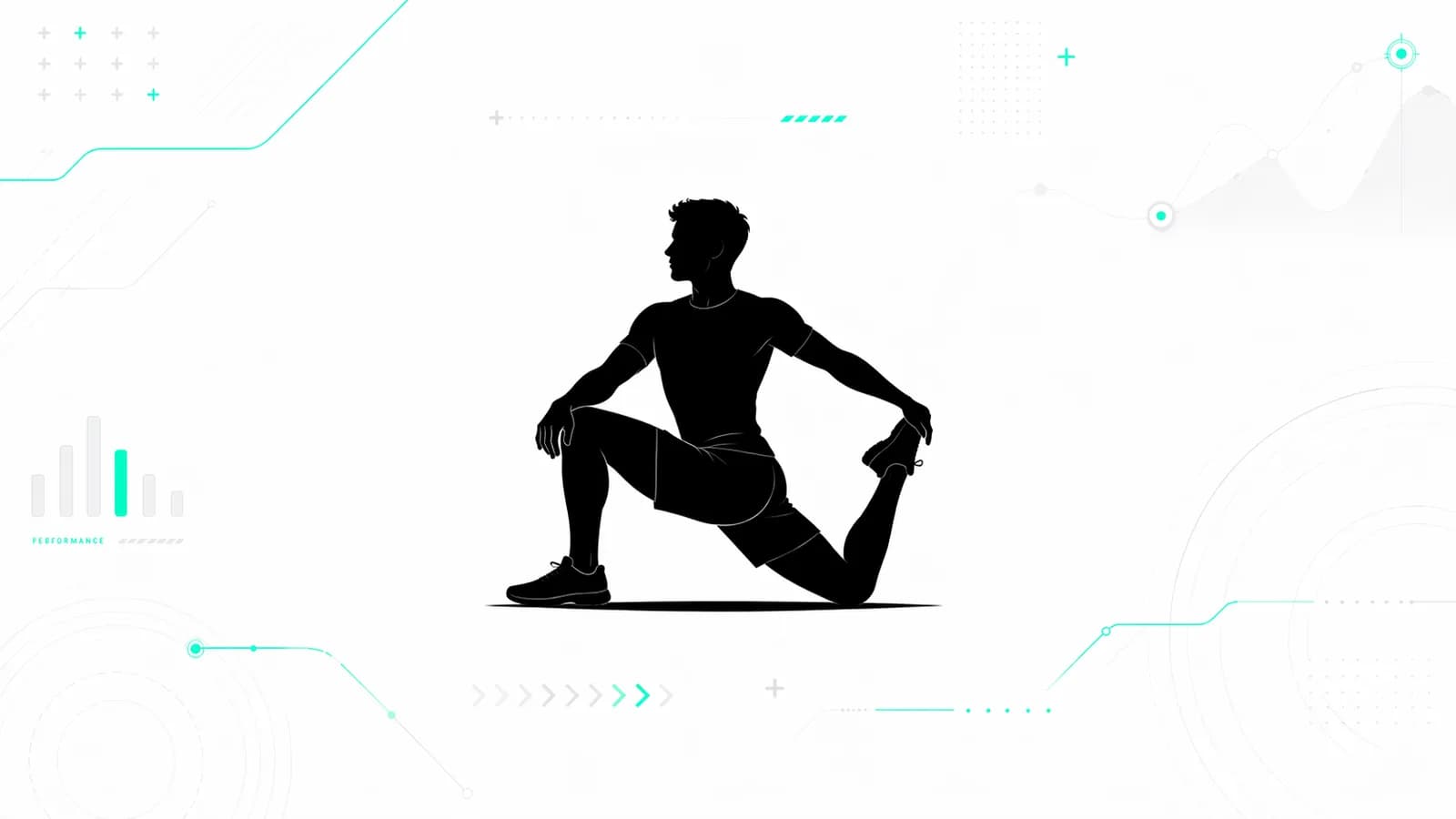
- Couch stretch (or simple long kneeling lunge): 45-60 sec per side
- Glute bridge: activates glutes, inhibits flexor hyperactivity
10-minute daily mobility routine
Sequence covering all areas in logical order:
- World's greatest stretch (lunge with rotation): 5 reps per side · 90 sec
- 90/90 hip stretch (both sides): 60 sec per side · 2 min
- Cat-cow + thread the needle: 10 reps + 5 per side · 90 sec
- Calf stretch on wall: 45 sec per side · 90 sec
- Couch stretch (flexors): 45 sec per side · 90 sec
- Shoulder CARs + doorway stretch: 30 sec + 30 sec per side · 2 min
Total: 10 minutes. Do it morning or pre-workout (as dynamic warm-up with active additions).
When you need a professional
If you have pain:
- Persistent in a specific area
- That increases with movement
- That radiates (e.g. from neck to arm)
Go to a physiotherapist, not internet, not chiropractor. Correct diagnosis makes the difference between 2 weeks of recovery and 6 months of worsening.
If you have mobility limits tied to training (e.g. can't do deep squat despite attempts), a specialised PT with background in kettlebell, crossfit or athletics often has the skills to unlock you.
Sports that improve mobility "for free"
Activities that naturally include mobility:
- Yoga (especially Vinyasa, Ashtanga): full body, 2-3 times/week
- Calisthenics: requires full range of motion, builds strength in lengthening
- Kettlebell (hardstyle): swing and turkish get-up work global mobility
- Martial arts: kicks need hip opening, punches need thoracic mobility
- Climbing: opening, grip, torsion
If you train weights 4x/week, 1-2 sessions of one of these add mobility without a separate program.
Common mistakes
- Static stretching only, without strength in new range → temporary gains
- Hold stretching 5 seconds: it's marketing. Need 30+ sec for the nervous system to register
- Bouncing during stretch (ballistic): high strain risk, ineffective
- Forcing pain: stretching should be "strong but tolerable tension", not sharp pain
- Doing everything the same day: better 10 min/day than 70 min once a week
- Ignoring recovery: muscles stiff from fatigue don't unlock with stretching, but with sleep
Watch the exercises in action
Related articles
- Muscle recovery: the complete guide to training more without breaking your body
- How many workouts per week you actually need to grow without breaking
- Ab and core exercises: complete guide with practical examples
Conclusion
Mobility isn't "yoga for hippies". It's the variable that lets you:
- Train without injuries
- Do full-range squats
- Move without pain in daily life
- Age without becoming stiff as a board
10 minutes a day, 4-5 times a week, for 8-12 weeks. Result: you physically change how you move. And you don't go back.
If you want a mobility program integrated with your training plan, a PT on Athleex builds it based on your specific limits. Try free.